July 12, 2026
Marie Curie Accepted Her Second Nobel Prize While Paris Published Love Letters Stolen From Her Lover
Subscribe
She won two Nobels in two sciences, refused to patent the element that killed her, and went to Stockholm to accept the second while Paris read her stolen love letters.
In late October 1911, twenty of the world's leading physicists gathered in Brussels for a closed-door conference organized by the Belgian industrialist Ernest Solvay. Among them were Ernest Rutherford, Max Planck, Henri Poincare, and a thirty-two-year-old Albert Einstein. There was one woman. Marie Curie, forty-three years old, a widow for five years, sat among these men as a peer. She had coined the term "radioactivity." She had discovered two elements. She had shared a Nobel Prize in 1903. And she was about to be awarded a second.
While she was in Brussels, a Parisian daily called Le Journal obtained intimate letters between Curie and the physicist Paul Langevin, a married former student of her late husband. The letters had been stolen from Langevin's apartment, reportedly by an investigator hired by his wife. On November 4, 1911, Le Journal published its scoop. The opening lines paired science and sex with a cruelty the period press perfected: "The fires of radium which beam so mysteriously...have just lit a fire in the heart of one of the scientists who studies their action so devotedly; and the wife and the children of this scientist are in tears" (AIP exhibit).
The campaign had a precursor. In January 1911, Curie had offered herself as a candidate for the French Academy of Sciences and lost to Edouard Branly by two votes, after right-wing newspapers spread rumors that she was Jewish, not truly French. She was not Jewish. She was Polish, Catholic by birth, atheist by choice.
Three days after Le Journal's article, on November 7, the Royal Swedish Academy of Sciences announced that Curie had won the Nobel Prize in Chemistry, "in recognition of her services to the advancement of chemistry by the discovery of the elements radium and polonium" (NobelPrize.org). The citation made no mention of her private life. The French press did nothing but.
Curie wrote to Le Temps, the newspaper of record for the French establishment, in a letter published November 8: "I consider any interference by the press and the public in private life to be abhorrent. This interference is especially criminal when it involves people who have manifestly dedicated their lives to causes of higher order and general benefit" (University of Turin academic paper).
The press did not stop. Anti-Semitic newspapers falsely declared her Jewish. Right-wing columnists claimed her affair with Langevin had begun while Pierre was alive, driving him to suicide. Pierre had been killed by a horse-drawn wagon in a Paris street. It was an accident. An angry mob gathered outside her home in Sceaux, terrifying her daughters, fourteen-year-old Irene and seven-year-old Eve. Curie and her children took refuge with friends in Paris.
Then the Nobel Committee itself wavered. Svante Arrhenius, a committee member, wrote to Curie suggesting she stay away from the Stockholm ceremony. The scandal, he implied, would embarrass the institution. Curie wrote back. Her reply was calm and absolute: "The prize has been awarded for the discovery of radium and polonium. I believe that there is no connection between my scientific work and the facts of private life. I cannot accept... that the appreciation of the value of scientific work should be influenced by libel and slander concerning private life" (Open Culture).
Einstein, who had met Curie for the first time at the Brussels conference, wrote to her on November 23. His letter was furious and tender: "I am so enraged by the base manner in which the public is presently daring to concern itself with you that I absolutely must give vent to this feeling." He told her: "Anyone who does not number among these reptiles is certainly happy, now as before, that we have such personages among us as you, and Langevin too, real people with whom one feels privileged to be in contact" (Physics Today).
Curie went to Stockholm. On December 11, 1911, she stood before the Swedish Academy and delivered her Nobel lecture on "Radium and the New Concepts in Chemistry" (NobelPrize.org). She did not mention the scandal. She began by establishing credit: "Before broaching the subject of this lecture, I should like to recall that the discoveries of radium and of polonium were made by Pierre Curie in collaboration with me." Then she drew the line between their roles with precision: "The chemical work aimed at isolating radium in the state of the pure salt, and at characterizing it as a new element, was carried out specially by me." And she folded the award back into the partnership the press had tried to desecrate: "I thus feel that I interpret correctly the intention of the Academy of Sciences in assuming that the award of this high distinction to me is motivated by this common work and thus pays homage to the memory of Pierre Curie."
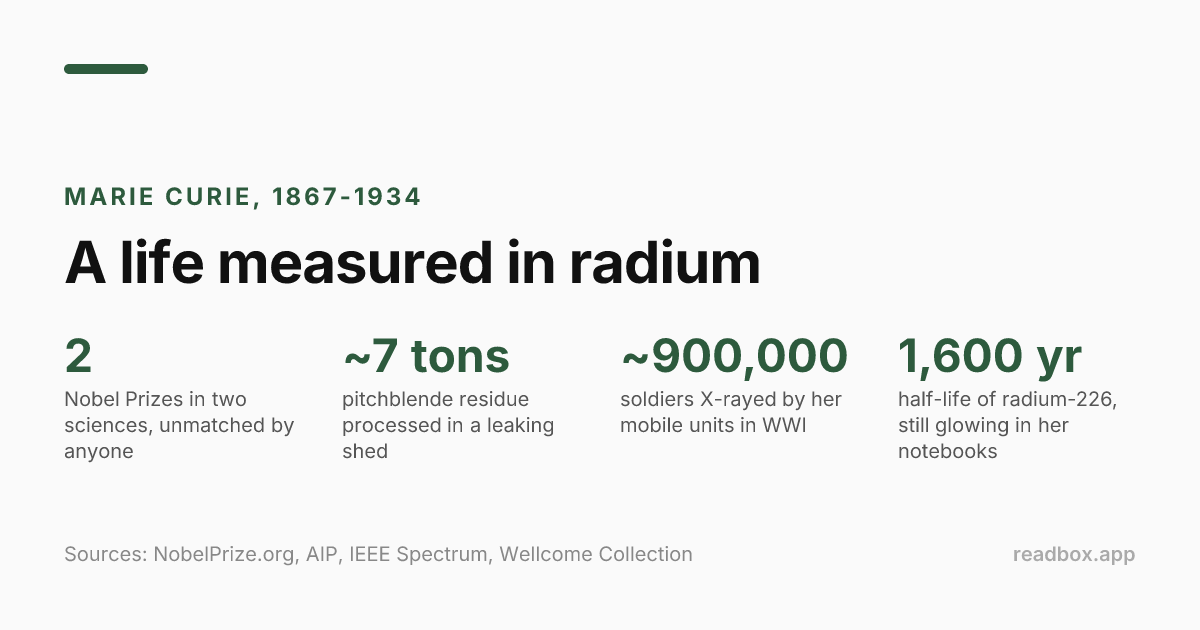
She remains, more than a century later, the only person ever to win Nobel Prizes in two different sciences.
The radium that won Curie the second Nobel, that the newspapers turned into a double entendre, came out of a shed.
When Marie and Pierre Curie began the search for new radioactive elements in 1898, they worked in a disused shed on the grounds of the Municipal School of Industrial Physics and Chemistry in Paris. Marie described it as having a bituminous floor and a glass roof that let in the rain. It was, she wrote, "like a hothouse in the summer, draughty and cold in the winter" (NobelPrize.org). The German chemist Wilhelm Ostwald, visiting from Berlin, said: "It was a cross between a stable and a potato shed, and if I had not seen the worktable and items of chemical apparatus, I would have thought that I was been played a practical joke."
The Curies needed tons of pitchblende, a uranium ore mined in St. Joachimsthal, Bohemia. The Austrian government donated several tons of the residue left after uranium extraction. From this residue, Marie had to separate the radioactive components by chemical analysis, step by step, measuring the activity after each separation. She processed twenty kilos of raw material at a time. She later wrote: "Sometimes I had to spend a whole day stirring a boiling mass with a heavy iron rod nearly as big as myself. I would be broken with fatigue at day's end" (NobelPrize.org).
The work took years. A ton of pitchblende residue contains about two to three decigrams of radium, a tenth of a gram at most. To obtain a pure salt, Marie performed, by her own account, "several thousands of crystallizations" (NobelPrize.org). She determined the atomic weight of radium as 226, placing it definitively on the periodic table as a new element, a heavier chemical cousin of barium.
The shed was not all misery. Marie remembered the nights: "One of our joys was to go into our workroom at night; we then perceived on all sides the feebly luminous silhouettes of the bottles of capsules containing our products." She called it "a lovely sight and one always new to us. The glowing tubes looked like faint, fairy lights" (Gizmodo, citing Curie's autobiography). The glow she admired was radium decaying. It was also irradiating her.
The Curies could have patented the radium extraction process. They chose not to. Marie explained: "It is a fortune which we have sacrificed in renouncing the exploitation of our discovery, a fortune that could, after us, have gone to our children." She concluded: "Yet, I still believe that we have done right" (IUPAC, citing Curie, National Bureau of Standards, 1921).
The decision was a philosophical position about what science is for. "We must not forget that when radium was discovered no one knew that it would prove useful in hospitals," Curie said. "The work was one of pure science. It must be done for itself, for the beauty of science" (sciencebusiness.net).
On April 19, 1906, Pierre Curie crossed a Paris street in the rain, slipped under a horse-drawn wagon, and was killed by a blow to the skull. He was forty-six. Marie was thirty-eight, with two daughters.
She kept a mourning journal, writing letters to Pierre as though he could read them. On May 14, 1906: "My little Pierre, I want to tell you that the laburnum is in flower, the wisteria, the hawthorn and the iris are beginning, you would have loved all that." She told him about her appointment to his chair at the Sorbonne: "I want to tell you, too, that I have been named to your chair, and that there have been some imbeciles to congratulate me on it." And: "I no longer love the sun or the flowers. The sight of them makes me suffer. I feel better on dark days like the day of your death, and if I have not learned to hate fine weather it is because my children have need of it" (AIP exhibit, from Eve Curie, Madame Curie, 1937).
I cannot conceive of anything which would give me real personal happiness, except perhaps scientific work, and not even that, because, if successful, I would be distressed that you didn't know about it. This laboratory gives me an illusion of preserving the remains of your life.
Marie Curie, mourning journal, May 14, 1906, in Eve Curie, Madame Curie (1937)
She went back to work. She had no choice, or rather, she had made the choice years earlier, when Pierre was still alive. As she wrote in her autobiographical notes: "Crushed by the blow, I did not feel able to face the future. I could not forget, however, what my husband used sometimes to say, that, even deprived of him, I ought to continue my work" (AIP exhibit, from Autobiographical Notes).
The woman who refused to stay home from Stockholm had not been welcome at any university when she was young.
Maria Sklodowska was born in Warsaw on November 7, 1867, the youngest of five children in a family of teachers. Poland had not existed as an independent country for most of a century. Warsaw belonged to the Russian Empire, and the czar's government prohibited women from attending university. Maria's brother could enroll at the University of Warsaw. She could not.
She joined what was called the Floating University, a clandestine night school that met in changing locations to avoid the police. In her autobiographical notes she described it as "a secret organization, which made everything extremely difficult" (AIP exhibit). The students' goal was not merely self-improvement. They believed that educating themselves and the working class was the path to Polish liberation. On Sundays and evenings, Maria also found access to a small municipal laboratory, where she experimented on her own. "At times I would be encouraged by a little unhoped-for success, at others I would be in the deepest despair because of accidents and failures resulting from my inexperience. But on the whole, though I was taught that the way of progress is neither swift nor easy, this first trial confirmed in me the taste for experimental research in the fields of physics and chemistry."
She and her older sister Bronya made a pact. Maria would work as a governess to pay for Bronya's medical studies in Paris. Once Bronya was established, she would support Maria's turn. Maria spent six years as a governess and tutor, teaching herself from textbooks by mail. She was twenty-four when she finally had enough money.
She arrived in November 1891 and registered at the Sorbonne as Marie, the French form of Maria. She lived in a garret: "The room I lived in was in a garret, very cold in winter, for it was insufficiently heated by a small stove which often lacked coal. During a particularly rigorous winter, it was not unusual for the water to freeze in the basin in the night" (AIP exhibit, from Autobiographical Notes). She prepared her meals on an alcohol lamp. She sometimes forgot to eat. But she was free. "All that I saw and learned that was new delighted me. It was like a new world opened to me, the world of science, which I was at last permitted to know in all liberty."
She finished first in her master's degree in physics in 1893, second in mathematics in 1894. She was one of twenty-three women among nearly two thousand men in the science faculty (Literary Review).
In the spring of 1894, a Polish physicist introduced her to Pierre Curie, a thirty-five-year-old researcher at the School of Industrial Physics and Chemistry. Within a year they were married. Pierre wrote to her before the wedding: "It would, nevertheless, be a beautiful thing in which I hardly dare believe, to pass through life together hypnotized in our dreams: your dream for your country; our dream for humanity; our dream for science. Of all these dreams, I believe the last, alone, is legitimate" (AIP exhibit, from Pierre Curie, pp. 72-77).
When the 1903 Nobel Prize in Physics was announced, Pierre insisted that Marie be included. Without his intervention, the award would have gone to him and Becquerel alone. He ensured the world knew what the French establishment was slow to acknowledge: that the science was hers as much as his.
When the First World War broke out in 1914, Curie saw a way to use what she knew. X-ray machines existed only in city hospitals, far from the front. She outfitted automobiles with X-ray equipment and portable generators, creating the first mobile radiological units. The French soldiers called them "petites Curies." She learned to drive, to change tires, to clean carburetors. She trained 150 women to operate the equipment. By the end of the war, the units had examined roughly nine hundred thousand wounded soldiers (AIP exhibit; IEEE Spectrum).
She wrote to her daughter Irene from the front: "Dear Irene, After various wanderings, we've arrived here... We hear the guns grumbling almost constantly" (AIP exhibit). Irene, not yet eighteen, served as her assistant.
The war work exposed Curie to still more radiation. She had been carrying test tubes of radium in her pockets for years, storing them in her desk drawer, remarking on the faint light they gave off in the dark. She never used shielding. The concept did not yet exist.
Marie Curie died on July 4, 1934, at the Sancellemoz sanatorium in Passy, France. She was sixty-six. The cause was aplastic anemia, a failure of the bone marrow to produce blood cells, attributed to her long exposure to radiation (NobelPrize.org).
Her laboratory notebook from 1899 to 1902 is still radioactive. Contaminated with radium-226, which has a half-life of approximately 1,600 years, it is kept in a lead-lined box at the Bibliotheque nationale de France. Anyone who wishes to consult it must sign a liability waiver and wear protective clothing (Wellcome Collection; CS Monitor).
Einstein once said of her: "Marie Curie is, of all celebrated beings, the only one whom fame has not corrupted" (The Marginalian, citing Walter Isaacson). In 1995 she became the first woman to be entombed in the Paris Pantheon on her own merits. Her coffin was lined with lead. Her daughter Irene won the Nobel Prize in Chemistry the following year, in 1935.
Curie herself, asked once to write an autobiography, dictated a single paragraph: "I was born in Warsaw of a family of teachers. I married Pierre Curie and had two children. I have done my work in France" (Literary Review). In her autobiographical notes she wrote: "There may be in a life some general direction, some continuous thread, due to a few dominant ideas and a few strong feelings, that explain the life and are characteristic of a human personality" (Autobiographical Notes).
The thread was radium. She followed it from a freezing garret in Paris to a leaking shed, from the shed to a Nobel Prize in Stockholm, from Stockholm to the battlefields of France, and from there to a sanatorium where she died of the very thing she had spent her life pulling, with her bare hands, out of the earth.
Read the full life: The Elements of Marie Curie by Dava Sobel (Atlantic Monthly Press, 2024).
Want the next one?
Every new The 15-Minute Biography issue by email. One tap to unsubscribe.