July 14, 2026
Alexander von Humboldt: The Most Famous Scientist in the World, Erased by a War He Didn't Live to See
Subscribe
He climbed a volcano thought to be the world's tallest, saw nature as one living web, became the idol of Darwin and Bolívar, and was wiped from English-language memory by an anti-German frenzy that broke out fifty-five years after he died.
On the morning of June 23, 1802, a thirty-two-year-old Prussian named Alexander von Humboldt set out from the Indian village of Calpi, on the high tableland of what is now Ecuador, to climb a mountain. Chimborazo was then believed to be the tallest on Earth. He carried a barometer, a thermometer, a sextant, and a cyanometer of his own invention for measuring the blueness of the sky. His shoes had disintegrated; he climbed on, barefoot, with an injured foot, alongside the French botanist Aimé Bonpland and a young Quiteño companion, Carlos Montúfar.
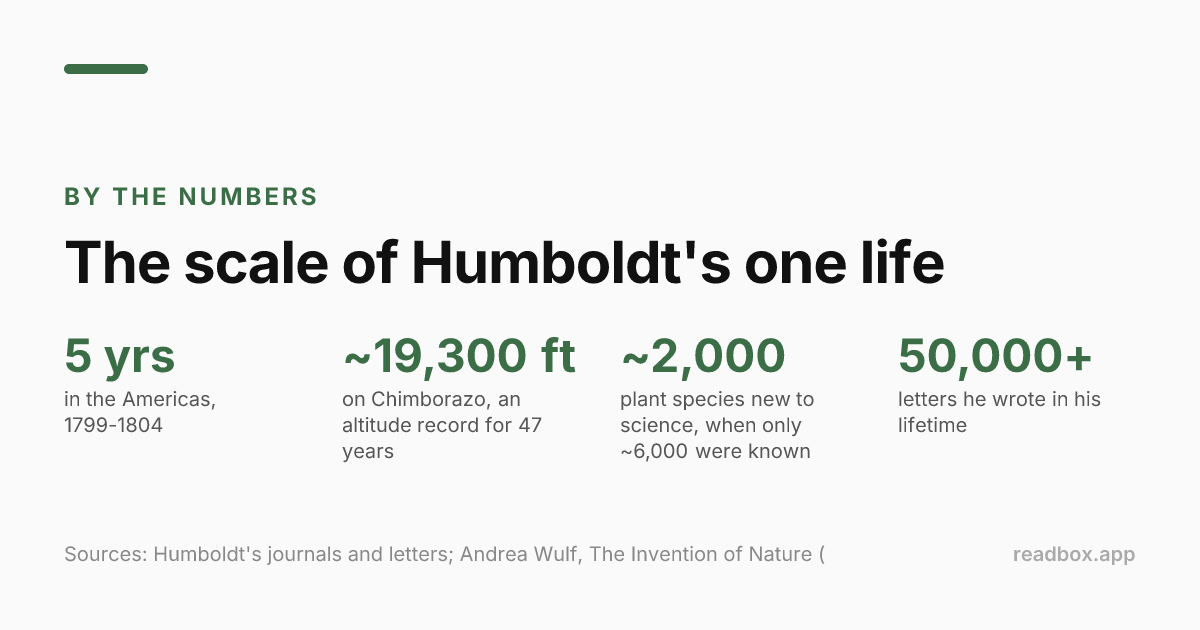
Higher than anyone is known to have stood before, the party was stopped by a crevasse. Humboldt put his height at about 3,016 toises, roughly 19,300 feet, and in a letter to his brother Wilhelm he reported that "we succeeded in approaching to within about 250 toises of the summit of the immense colossus of Chimboraco." The record he set that day stood for forty-seven years, until a botanist surpassed it by a few meters in the Himalayas in 1849.
He did not climb for the record. He climbed to see. Standing at the edge of what he could breathe, looking down the slopes where tropical forest gave way to alpine grasses and then to lichen on bare rock, something crystallized. The mountain was not a pile of isolated facts. It was a system. In his own account, written years later, he noted almost drily that the public cared only about the summit: "Chimborazo has been the wearisome object of all inquiries addressed to me since my first return to Europe." What interested him was the banding below, the way life arranged itself by altitude and temperature and moisture into zones that rhymed with zones he had seen in the Alps and the Pyrenees half a world away. Every plant, every reading, was a thread; the mountain was the loom. He would later say that "on the 22d June 1799, I was in the crater of the Peak of Teneriffe," and that "three years afterwards, almost on the same day," he had reached a point 6,700 feet higher. The two climbs, in his mind, were one continuous act of comparison.
That climb was the hinge of a life, and it nearly did not happen. Humboldt was born in Berlin on September 14, 1769, the younger son of a court chamberlain whose death when Alexander was nine left the boy to a cold, severe mother of Huguenot descent. She wanted him safe in the Prussian civil service. He complied, dutifully, becoming an inspector of mines, a job that at least let him travel the kingdom and poke at geology, anatomy, and electricity on the side. Privately he was frantic. "There is a drive in me," he wrote in a letter, "that often makes me feel as if I'm losing my mind." He likened it to being chased perpetually by ten thousand pigs.
What freed him was her death. His mother died of cancer in 1796, when he was twenty-seven, and he did not attend the funeral. He quit the mines, took the considerable inheritance, and began planning what he called a "great voyage." The destination barely mattered at first; he considered the West Indies, Lapland, Greece, and Siberia. He had no single object of study. He wanted to find out how, as he put it, "all forces of nature are interlaced and interwoven," taking as his premise that the Earth was "one great living organism where everything was connected." A year before the inheritance freed him, he had written to a friend: "I have so much money that I can get my nose, mouth, and ears gilded."
In Paris he met the botanist Aimé Bonpland in 1798, and the two planned an expedition to the tropics. The enabling stroke was diplomatic. In March 1799, at the court of Aranjuez, King Carlos IV of Spain handed Humboldt passports to his South American colonies. In his own narrative Humboldt called it an unprecedented grant: "Never had so extensive a permission been granted to any traveller, and never had any foreigner been honoured with more confidence on the part of the Spanish government." He and Bonpland sailed that summer, and near Caracas he looked up and saw the Southern Cross for the first time. He had arrived.
For five years, from 1799 to 1804, they moved through Venezuela, Cuba, Colombia, Ecuador, Peru, Mexico, and the United States. He identified about two thousand plant species new to science, at a time when only roughly six thousand were known to European botany. He confirmed that the Orinoco and the Amazon were linked by the Casiquiare, a natural canal no European had mapped, settling a geographical puzzle the Spanish had kept secret for centuries. In a letter from Cumaná he described descending the Orinoco for five hundred leagues in twenty-six days, portaging his dugout canoe overland between river systems, sleeping in huts of heliconia leaves, his boots rotting off his legs. He held live electric eels and took their shocks; on the Venezuelan plains he had wild horses driven into a muddy pond to rile the eels to the surface, and watched, fascinated, as the horses screamed and the water "boiled with movement." He mapped the magnetic equator, drank from rivers and ranked them by taste, transcribed indigenous vocabularies, and sketched Inca monuments deep in the rainforest. In Washington he spent a week with Thomas Jefferson, who called him "the most scientific man of his age," and handed Jefferson and his cabinet intelligence on how Spain governed its colonies, knowledge they badly wanted after the Louisiana Purchase. Treasury Secretary Albert Gallatin said Humboldt was "a fountain of knowledge which flows in copious streams" and talked "twice as fast as anybody I know."
The scientific haul was the lesser half of it. What set Humboldt apart was what he noticed about people and land together. On a slave plantation in the valley of Lake Valencia, in Venezuela, he watched planters drain the land and fell the surrounding forest, and saw the streams thin and the soil die. He became, as later historians would put it, the first to relate colonialism to the devastation of the environment, and the first to explain that forests store water, cool the air, and hold the soil. He was an ecologist before the word existed.
He was also, uncomfortably for his reputation in his own time, an abolitionist who said so in print. Slavery he called a disgrace. In his Political Essay on the Island of Cuba he wrote that the fear of a revolt like Haiti's "undoubtedly operates more powerfully upon the minds of men, than do the principles of humanity and justice," and that to fix the evil "it is necessary to probe the sore; for there exists in social, as well as organic bodies, reparative forces, which, when well directed, may triumph over the most inveterate evils." The book was published in Paris in 1826, banned and pulled from libraries in Havana the next year, and then willfully mistranslated into English to mute his antislavery views. In a private essay he kept in his diary and never published, he asked what produced "ce malaise dans lequel tout homme sensible se trouve dans les Colonies européennes," the unease every sensitive man feels in European colonies, and answered that "l'idée de la Colonie même est une idée immorale," the very idea of a colony is an immoral one, and that every colonial government is a government of distrust. He kept that essay from publication. The published man was bold enough; the private one was sharper still.
He was a man of contradictions, as one of his biographers put it: a fierce critic of colonialism who cheered the Latin American revolutions, yet a chamberlain to two Prussian kings; an admirer of the United States and its liberty who never stopped criticizing its failure to abolish slavery; a man who called himself "half an American" and yet compared the country to "a Cartesian vortex, carrying away and levelling everything to dull monotony." He wanted, ideally, to be doing three things at the same time.
The Chimborazo climb became a diagram. Soon after his return to Europe, Humboldt drew the mountain in cross-section, its slopes labeled with the plants that lived at each elevation, flanked by columns of temperature, pressure, humidity, and the blueness of the sky. He called it his Tableau Physique, and in German a Naturgemälde, a painting of nature. It was the first picture of life as an interconnected web, the founding image of biogeography, and arguably the first modern infographic. Scientific illustrations, he insisted, should "speak to the senses without fatiguing the mind." He had a visual memory so precise he could recall a specimen seen on one continent and compare it with one seen years later on another, and the Tableau was how he made others see the connections he carried in his head. (Modern ecologists who re-surveyed the mountain two centuries later found the plants had migrated hundreds of meters upslope, a baseline Humboldt had unwittingly laid for measuring climate change.)
The connections were the product. In 1817 he drew isotherms, the lines of equal temperature that still ring every weather map, and invented what he called "comparative climatology," treating climate not as a list of local readings but as a system of correlations among atmosphere, ocean, and land. From the solar system to the Earth's core, he wrote in his late masterwork, Cosmos, every feature and organism was held together in a "net-like intricate fabric" of "never-ending activity"; "from pole to pole, one life is poured on rocks, plants, animals, and even into the swelling breast of man." Nature, he said, was "a living whole," not a "dead aggregate."
This was the worldview that dropped like a seed into the century's best minds. Goethe, his friend, called Humboldt "a fountain with many spouts from which streams flow refreshingly and infinitely, so that we only have to place vessels under them." Simón Bolívar read him and drew on his critique of empire for the independence generation. And a young Charles Darwin, at Cambridge, devoured Humboldt's Personal Narrative. In his autobiography Darwin wrote that the book, with Herschel's, "stirred up in me a burning zeal to add even the most humble contribution to the noble structure of Natural Science," and that "no one or a dozen other books influenced me nearly so much as these two." He carried Humboldt's maps aboard the Beagle. John Muir, planning his own walk into the South American wilds, wrote to a friend of "how intensely I desire to be a Humboldt." Thoreau's notebooks, around the time he was writing Walden, were full of the phrase "Humboldt says."
For the last decades of his life Humboldt was a one-man scientific clearinghouse in Berlin, writing more than fifty thousand letters and answering nearly twice as many, and running a global "magnetic crusade" that took two million observations from stations spread from St. Petersburg to Peking to Alaska to Jamaica. In 1829, at sixty, he made one more great journey, some sixteen thousand kilometers across Siberia and the Russian steppe, where he noted the deforestation and the "great masses of steam and gas" rising from industrial centers. Back in Berlin he delivered free public lectures on physical geography that drew thousands, and from them built Cosmos. He published its first volume in 1845, at seventy-six, and kept going: volume two at seventy-eight, three at eighty-one, four at eighty-nine. The first volume sold twenty thousand copies in two months and was translated into nearly every European language. His books were so eagerly awaited that readers bribed booksellers to get them first, and yet, from the cost of producing them, he died a poor man. By common reckoning he was the most famous scientist in the world, and after Napoleon the most famous man in Europe.
Then he vanished from the English-speaking world, and the mechanism was almost mechanical. He died on May 6, 1859, at eighty-nine, and his funeral in Berlin was the grandest ever accorded to a private German, tens of thousands following the hearse for a mile behind the king's horses. American newspapers called him "the most remarkable man ever born." A decade later, on the centennial of his birth in 1869, twenty-five thousand people gathered in Central Park, President Ulysses Grant joined a huge celebration in Pittsburgh, fifteen thousand marched in Syracuse, and The New York Times gave its entire front page to the global festivities. His monarch, Friedrich Wilhelm IV, had called him "the greatest man since the Deluge."
But Humboldt was a Prussian nobleman, and the First World War washed him out of Anglo-American memory. Anti-German sentiment after 1914, the specialization and splintering of the sciences, and the simple passage of time did the rest. He was eclipsed by the disciples who had stood on his shoulders, Darwin and Thoreau and Muir among them, until his ideas became so obvious that the man behind them disappeared. "Alexander von Humboldt has been largely forgotten in the English-speaking world," the historian Andrea Wulf writes. "It is almost as though his ideas have become so manifest that the man behind them has disappeared." The places kept his name, hundreds of them: the Humboldt Current off Chile and Peru, a glacier in Greenland, a penguin, a hog-nosed skunk, a crater on the moon, counties and towns and national parks across the Americas. The man did not keep it.
He is supposed to have known he was dying, and to have said, from his sickbed, "How glorious these sunbeams are! They seem to call Earth to the Heavens." The line may be too perfect to trust. But the life it suits is real, and worth retrieving: a man who insisted that nothing in nature could be understood alone, who saw the web before we had the word for it, and who got erased by the very nationalism he had spent a lifetime writing past.
Read the full life in Andrea Wulf's The Invention of Nature: Alexander von Humboldt's New World (Knopf, 2015), the biography that did more than any other to bring him back, after Helmut de Terra's 1955 life and Gerard Helferich's Humboldt's Cosmos had kept the candle lit. For Humboldt in his own words, his Personal Narrative of Travels to the Equinoctial Regions is free online, and his own account of two attempts to ascend Chimborazo survives in full.
Want the next one?
Every new The 15-Minute Biography issue by email. One tap to unsubscribe.