July 15, 2026
Hildegard of Bingen Was Walled Up at Eight and Preaching to Bishops at Sixty
Subscribe
A girl given to the Church as a tithe hid her visions for forty years, then made a Pope's blessing her permission to write, preach, and compose, and made the Devil the only character in her play who could not sing.
The ceremony was a burial. Before a girl was sealed into an anchorite's cell, she lay on a bier and received last rites from the bishop, because the church considered her dead to the world from that day forward. Around the year 1106, a sickly child of about eight was handed into just such a cell at the Benedictine monastery of Disibodenberg, in the Palatinate forest of what is now western Germany. She was the tenth child of a minor noble family, Hildebert and Mechtild of Bermersheim, given to the Church as a tithe because a household could not count on feeding her. The girl was placed under the care of a young noblewoman named Jutta von Sponheim, who had chosen to be walled up as a recluse rather than enter a convent. The cell adjoined the monks' church so the women inside could hear the offices through a window. Food came in through that window, and refuse went out, and that was the link to the rest of humanity.
The child's name was Hildegard. She would live in that cell, and in the small community of women that grew up around it, for more than thirty years, and she carried a secret into the wall with her. She later said she had first seen what she called "the Shade of the Living Light" at the age of three, and that by five she understood she was experiencing visions. She confided in no one except Jutta, and, through Jutta, a monk named Volmar who became her tutor and, much later, her secretary. As a child she once asked a nurse whether she too saw such things, and when the nurse said no, a great fear fell on her. She learned to hide it. The hiding would last most of her life.
What makes Hildegard of Bingen (1098-1179) worth fifteen minutes is not that a medieval woman had visions. Plenty did. It is the mechanism by which she turned a private, secret experience into public authority in a system designed to give women none, and then used that authority to preach, compose, rebuke emperors, and refuse to dig up a corpse. The whole career turns on one decision, made around the age of forty-three, to stop hiding and ask for permission from exactly the men whose blessing would make her unassailable.
She never learned to write polished Latin. Jutta had taught her to read the Psalter and sing the office, but her grammar stayed rough her whole life; she always relied on secretaries to put her words onto parchment. She was frank about this. In a letter written late in her life to a persistent monk named Guibert of Gembloux, she described how the visions arrived, the closest thing we have to her own phenomenology:
The words I speak are not my own, nor any human being's. I merely report those things I received in a supernal vision. I do not hear these things with bodily ears, nor do I perceive them with the cogitations of my heart or the evidence of my five senses. I see them only in my spirit, with my eyes wide open, and thus I never suffer the defect of ecstasy in these visions.
She insisted she was awake, not in a trance, and that the light she saw was not local or spatial but "far brighter than a lucent cloud through which the sun shines." She named it "the shadow of the Living Light." Sometimes, she said, she saw another light inside that light, which she called "the Living Light," and "when I do see it, all my sorrow and pain vanish from my memory and I become more like a young girl than an old woman." (That letter appears in Joseph Baird's translation of The Letters of Hildegard of Bingen, Oxford University Press.) Modern neurologists, beginning with Oliver Sacks, have suggested the visions and their crippling headaches resemble migraine aura. The bodily cost was real either way: she was bedridden for long stretches, and she believed the sickness came when she resisted the command to speak.
The command arrived in 1141. She was forty-two years and seven months old. In the declaration that opens her first book, Scivias ("Know the Ways"), she wrote that Heaven opened and "a fiery light of exceeding brilliance came and permeated my whole brain, and inflamed my whole heart and my whole breast, not like a burning but like a warming flame, as the sun warms anything its rays touch. And immediately I knew the meaning of the exposition of the Scriptures." A voice told her, in the standard Paulist Press translation by Mother Columba Hart and Jane Bishop: "O fragile human, ashes of ashes, and filth of filth! Say and write what you see and hear."
She refused. For a long time she refused. "I, though I saw and heard these things, refused to write for a long time through doubt and bad opinion and the diversity of human words, not with stubbornness but in the exercise of humility, until, laid low by the scourge of God, I fell upon a bed of sickness." She interpreted the illness as punishment for her silence, and only then, "compelled at last by many illnesses," and urged by the nun Richardis von Stade and by Volmar, did she set her hand to writing.
Here is the decision that made everything else possible. A woman in twelfth-century Germany who claimed divine visions and published them without cover was one bad hearing away from being branded a heretic, and the 1140s were a season of schism and roaming preachers drawing exactly that charge. In 1146 Hildegard wrote to the most powerful churchman in Christendom, Bernard of Clairvaux, the Cistercian abbot then preaching the Second Crusade, and asked him whether she should "say these things openly or whether I should keep quiet." She framed herself in the language of weakness her century expected of women, calling herself "miserable and more than miserable in my womanly existence," while quietly handing Bernard the evidence of a mind he could not dismiss: "I who am miserable and more than miserable in my womanly existence have seen great wonders since I was a child." (That letter survives in the Columbia Epistolae project and in Mark Atherton's Penguin edition of her Selected Writings.)
Bernard's reply was short and noncommittal. "We wish you joy in the grace of God that is within you," he wrote, "and for our part we beseech you to acknowledge it as grace and to respond with all the affection of humility and devotion, knowing that 'God opposes the proud and gives grace to the humble.'" But he did something more useful than answering fully: he carried her case to the Pope. Eugenius III, himself a former monk of Clairvaux, was at the Synod of Trier in the winter of 1147-48. A portion of the unfinished Scivias was read aloud to him there. With Bernard speaking in her favour, the Pope sent Hildegard a letter of blessing, later construed as papal approval for the whole of her public career. She wrote back to Eugenius, again in the language of humility that opened every door for her: "O gentle father, poor little woman though I am, I have written those things to you which God saw fit to teach me in a true vision, by mystic inspiration." And then she named the resistance she was buying cover against: "In their instability, many people, those wise in worldly things, disparage these writings of mine, criticizing me, a poor creature formed from a rib, ignorant of philosophical matters."
A Pope's blessing was not a footnote. It was the mechanism. With it, the woman walled in at eight became a woman the church could not easily silence.
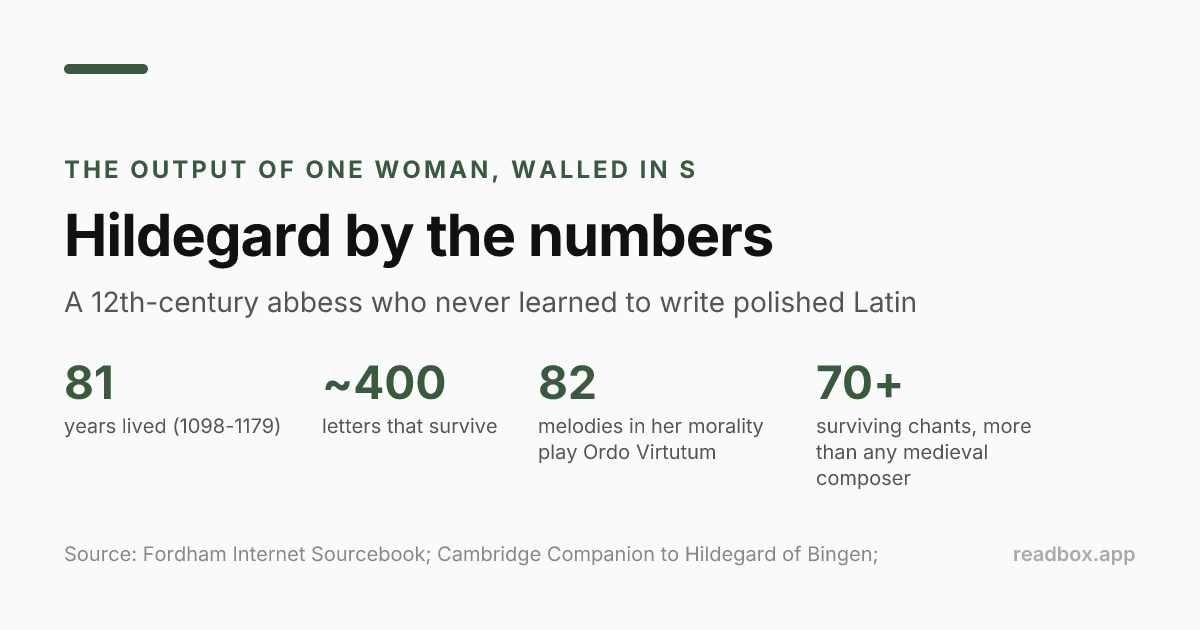
She finished Scivias in 1151, ten years after the first command, and did something with it no one had quite done before. It ends with the text of a sung drama, the Ordo Virtutum ("Play of the Virtues"), which she then expanded into a stand-alone work of eighty-two melodies. It is the earliest surviving morality play by more than a century, and the only medieval musical drama to survive with both words and music attributed to a single author, probably performed by her nuns at the dedication of her new church around 1152. Its plot is an allegory: a soul, Anima, is tempted away from the Virtues by the Devil, falls, repents, and is rescued. The decisive artistic choice is one Hildegard made about the Devil. Every other character sings. The Devil alone speaks, shouts, and growls, because, as the music scholar Peter Dronke and others have argued, Hildegard believed song was a divine faculty and denied it to the figure of evil. The being who fell from heaven is the one being in the play with no music in him.
By the time she composed it, she had moved. Around 1147-1150 she pulled her growing community of women out of Disibodenberg, where they had lived alongside the monks, and founded her own convent at Rupertsberg, on the Rhine near Bingen, at one of the river's busiest junctions. The abbot of Disibodenberg resisted, standing to lose the women's dowries and their labour. She pushed through anyway, citing, as she always did, a divine command. At Rupertsberg she was her own abbess, on her own ground, with her own scriptorium. She later founded a daughter house at Eibingen across the river, around 1165.
From Rupertsberg she ran a correspondence that survives in roughly four hundred letters, to popes, emperors, archbishops, abbots, and ordinary petitioners, one of the largest bodies of personal correspondence to come down from the entire Middle Ages. She did not write only to ask. She told the Holy Roman Emperor Frederick Barbarossa, who had met her at Ingelheim and granted her convent an imperial charter of protection in 1163, that he was on the wrong road in his schism with the papacy: "O king, it is imperative for you to have foresight in all your affairs. For in a mystic vision I see you like a little boy or some madman living before Living Eyes." She sided with Pope Alexander III against the antipopes Frederick had installed, yet kept the Emperor's protection anyway, a balancing act that required a reputation no one dared test. She was called, in her own lifetime, the Sibyl of the Rhine.
And she preached. Between 1158 and 1170 she undertook four journeys through the German lands, preaching in the cathedral cities of Cologne, Trier, Metz, Wurzburg, and Bamberg. Public preaching by a woman was effectively unheard of in the twelfth century. A modern Hildegard scholar, Hildegard Gosebrink, cautions that the detailed itineraries are partly a twentieth-century reconstruction, and that the evidence comes through the Vita and through letters in which clergy asked her for a written copy of what she had said. The fact of the preaching, and the letters requesting it, are real. She filled a role she believed the male clergy had vacated through corruption, denouncing simony and clerical sexual laxity, telling one group of churchmen they were "prostrate and no support for the church" who "flee into the caves of your lust."
Meanwhile she kept producing. After Scivias came the Liber Vitae Meritorum ("Book of Life's Merits," 1158-1163) and the Liber Divinorum Operum ("Book of Divine Works," completed when she was well into her seventies). Alongside them she wrote two works of natural history and medicine, the Physica and the Causae et Curae, the only major works of hers that claim no divine revelation. She invented a private constructed language, the Lingua Ignota, with its own alphabet. More of her chants survive than of any other composer from the entire Middle Ages.
Her last fight was the one that cost her the most, and it was about a corpse. In 1178, when she was eighty and had a year to live, she allowed the body of a nobleman to be buried in the consecrated cemetery at Rupertsberg. The man had at some point been excommunicated. The prelates of the archbishopric of Mainz, acting for an archbishop away in Rome, ordered her to dig the body up and cast it out of holy ground. Hildegard refused. Her argument was that the man had confessed, received the last sacraments and communion before he died, and was therefore reconciled to the Church. She put it in writing: "We have not presumed to remove the body of the deceased inasmuch as he had confessed his sins, had received extreme unction and communion, and had been buried without objection." (That letter, numbered 23, "Hildegard to the Prelates at Mainz," is reproduced in translation at Goodnews.ie.) According to the later canonization protocol she went further and had the grave markers cleared so the body could not be disinterred without her knowledge.
The prelates answered with the one punishment that could actually wound her. They placed Rupertsberg under interdict: no Mass, no Eucharist, and, cruelest of all for a convent that existed to sing the divine office, no singing. The community fell silent. Hildegard obeyed the ban's terms, but she argued back, and the argument she made is the nearest thing she left to a theology of music. "Those who without just cause impose silence on a church and prohibit the singing of God's praises," she wrote, "will lose their place among the chorus of angels." She grounded the case in Genesis: Adam, before the Fall, had a voice that blended with the angels' praise, and music was the art that reached back toward that lost harmony. To take it away was not a discipline but a desecration. She even named her age for them: "This time is a womanish time, because the dispensation of God's justice is weak. But the strength of God's justice is exerting itself, a female warrior battling against injustice, so that it might be defeated."
She won, though barely. She reached the archbishop, produced witnesses to the dead man's absolution, and the interdict was lifted. She died on September 17, 1179, at eighty-one, and was buried in the church at Rupertsberg. Efforts to canonize her began in 1233 under Gregory IX and continued under Innocent IV, but never formally completed. Her name sat in the Roman Martyrology, her feast was kept locally in the German dioceses, and there the matter largely rested for centuries. Her music was rediscovered by musicologists in the late twentieth century; the 1985 recording A Feather on the Breath of God by the ensemble Gothic Voices, taking its title from a phrase in Scivias, made her a bestseller eight centuries after she wrote the notes. In 2012, Pope Benedict XVI proclaimed her a saint and named her a Doctor of the Universal Church, one of only four women ever to hold that title. The apostolic letter noted that Pope Eugenius III had "in 1147 authorized her to write and to speak in public," and that "the corpus of her writings, for their quantity, quality and variety of interests, is unmatched by any other female author of the Middle Ages."
The woman who entered the world's memory through a window in a wall had, by then, been famous, forgotten, and famous again. The mechanism she understood at forty-three had not changed. Authority in her church flowed from the top down, so she went to the top, asked for permission in the language of weakness, and used the grant to do whatever she pleased. The Devil in her play could not sing. She made sure no one could make her stop.
Read the full life in Sabina Flanagan's Hildegard of Bingen: A Visionary Life (Routledge, 2nd ed. 1998), the standard scholarly biography, which traces her from the anchorite's cell to her death as a correspondent of popes and kings. For her own words, the Paulist Press Scivias (translated by Mother Columba Hart and Jane Bishop) and Baird's edition of the letters are the places to start.
Want the next one?
Every new The 15-Minute Biography issue by email. One tap to unsubscribe.