July 16, 2026
Billie Jean King Built Women's Pro Tennis on Tobacco Money, Then Lost Every Endorsement for Telling the Truth
Subscribe
She turned a 750-pound Wimbledon check into the Women's Tennis Association, a cigarette sponsor into equal prize money, and a 90-million-viewer spectacle into legitimacy, then held a press conference nobody wanted her to hold and paid for it in 24 hours.
On July 5, 1968, a twenty-four-year-old Californian walked off Centre Court with the Wimbledon trophy and, for the first time in the tournament's history, a winner's check. Princess Marina of Kent handed Billie Jean King the silver Venus Rosewater Dish. Then came the money. King had just beaten the Australian Judy Tegart in the first Wimbledon of the Open era, the moment tennis finally let professionals compete for pay and ended decades of "shamateurism," the system that quietly slipped cash to top players under the table. This was supposed to be the breakthrough. King collected her check for 750 pounds. Then she learned what Rod Laver, the men's champion, had collected for doing the same job on the same courts: 2,000 pounds.
King looked at the two figures and thought, as she later recalled, "Wow, that's a pretty big difference" (Tennis.com). Years afterward she put the same moment another way to a reporter: "Oh God, here we go again ... argh, there's another battle, we've got pro tennis" (The Guardian). She had spent eight years on the amateur circuit believing her dream of making a living with her racquet was finally arriving. Now the reward had arrived, and it was worth roughly thirty-eight cents on the male champion's dollar. The 750 pounds were not the insult. The insult was the proof that going professional had changed nothing about who got paid, only about who got paid less.
That check is where the rest of her life begins, because Billie Jean King did not file a complaint or wait for the establishment to fix itself. She built a parallel economy for women's tennis, almost from scratch, and the engine she used to do it was a cigarette company. Then, at the height of her fame, she told a truth that the same economy could not afford, and the market punished her for it in a single day.
A country-club sport, entered from the outside
Billie Jean Moffitt was born on November 22, 1943, in Long Beach, California, the daughter of a firefighter and a homemaker. The family was working class and obsessively athletic. Her father, Bill, had earned a tryout with an NBA team before joining the fire department. Her brother, Randy, would pitch more than a decade in Major League Baseball. Billie Jean played shortstop on a girls' softball team that won the Long Beach championship. At eleven, her parents nudged her toward a "more ladylike" sport. She saved eight dollars from odd jobs, bought her first racquet, and took a free lesson on the public courts at Houghton Park from a city coach named Clyde Walker.
She told her mother, "I am going to be No. 1 in the world" (billiejeanking.com; National Women's History Museum). A year later, at the Los Angeles Tennis Club, she had what she has called an epiphany. In her own words, from a later interview: "At twelve, which was one year later, I had an epiphany at the Los Angeles tennis club that I would dedicate my life to equal rights and opportunities for boys and girls, men and women, for the rest of my life. I noticed that everybody who played tennis was white. The clothes were white, the balls were white, the socks were white, the shoes were white, and I said, where's everybody else?" (Rutgers Institute for Women's Leadership).
The sport she had fallen into was a country-club sport, and she had entered it from the public courts. At her early tournaments she was once barred from a group photograph because she wore tennis shorts her mother had sewn, rather than the regulation white dress. She won her first Wimbledon title in 1961, the women's doubles with Karen Hantze, at seventeen, and still could not land a college sports scholarship. She married a law student named Larry King in 1965, and he would become the business mind behind much of what she built. But the gap she had seen at twelve, between the sport's insiders and everyone else, was the same gap she saw magnified in that 1968 check.
Nine women, nine one-dollar contracts, and a tobacco sponsor
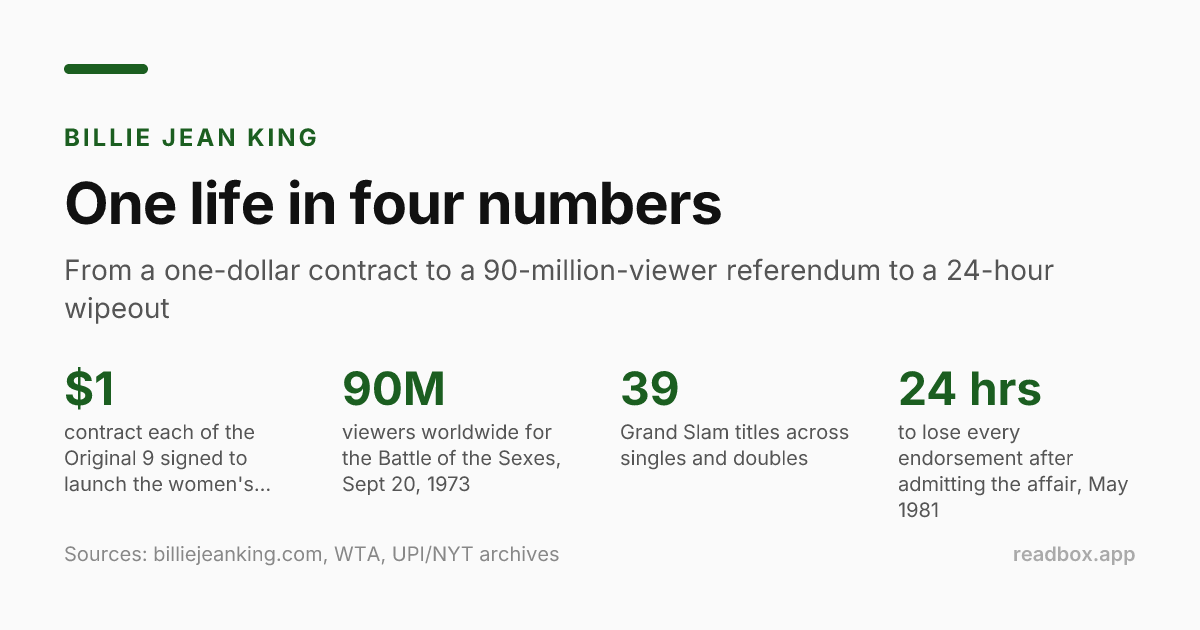
By 1970 the pay ratio at some tournaments had reached eight to one. The breaking point was the Pacific Southwest Championships in Los Angeles, run by the former men's champion and promoter Jack Kramer, where the men's winner would get $12,500 and the women's winner $1,500, and women's expenses were not even covered unless they reached the quarterfinals. King and eight other players, the group now called the Original 9, decided not to play. They went instead to Gladys Heldman, the publisher of World Tennis magazine, who helped them stage their own event in Houston. On September 23, 1970, each of the nine signed a one-dollar pro contract with Heldman's company (International Tennis Hall of Fame; AP News).
The one-dollar contract was not symbolism. It was a legal device. By becoming "contract pros" with Heldman, the players shielded themselves from lawsuits by the tennis establishment, which promptly threatened to ban them from Grand Slams and strip their national rankings. The money to actually run the event came from a friend of Heldman's: Joseph Cullman, the chief executive of Philip Morris, who put up $2,500 for naming rights to a cigarette brand he owned. The tournament was called the Virginia Slims Invitational. Its slogan, printed on the brand's ads, was "You've Come a Long Way, Baby."
This is the mechanism worth pausing on. Women's professional tennis, the institution that would become a global tour worth hundreds of millions in annual prize money, was bootstrapped with tobacco money and a one-dollar legal fiction. The players had no leverage except the willingness to be expelled, no funding except a cigarette company that saw a marketing angle in feminism, and no guarantee any of it would work. It worked. By the end of 1970 the circuit had grown from nine to forty members. In 1971 it ran twenty-one tournaments, and King became the first female athlete to earn over $100,000 in a single season (WTA). The sponsors and the fans the establishment insisted did not exist turned out to exist the moment someone gave them a tour to watch.
The association, the ultimatum, and equal pay at the US Open
The circuit proved the market. It did not solve the politics. The women were still a splinter tour, and the United States Lawn Tennis Association still controlled the major events. In 1972, King won the US Open and collected $10,000. The men's champion, Ilie Nastase, collected $25,000. King announced that if the prize money was not equal the next year, she would not play (billiejeanking.com; Encyclopedia.com).
The structural answer came on June 21, 1973, a week before Wimbledon, in a meeting room at the Gloucester Hotel in London. King had spent a year quietly persuading players from the rival establishment tour to join. Roughly sixty players showed up. She asked the Dutch player Betty Stove to guard the door, as Rosie Casals later recalled, and not let anyone leave until they had formed an association (BBC Sport). They emerged with the Women's Tennis Association, and King as its first president. Her reasoning for the form it took was practical: "We knew we had to be an association, not a union, because as athletes we were private contractors" (WTA). Larry King, her husband, drafted the bylaws.
A united women's front gave King the bargaining power she needed. In 1973 the US Open became the first major tournament to offer equal prize money to men and women. The extra money to close the gap was found through a sponsor, the deodorant brand Ban. It would take another thirty-four years before all four Grand Slams matched it; Wimbledon held out until 2007 (billiejeanking.com; Los Angeles Times). King had built the leverage, made the threat credible, and then used the credibility to extract the result. That is the whole sequence in one sentence.
The match that was really a referendum
The same year, 1973, produced the event that made her a household name and that she would spend the rest of her life explaining was never really about tennis. Bobby Riggs, a fifty-five-year-old former men's champion and self-described hustler, had been goading the top women into matches to prove the men's game was superior. In May he beat Margaret Court, the world number one, 6-2, 6-1, a drubbing the press called the Mother's Day Massacre. King had turned Riggs down before. After Court lost, she decided she had no choice. If she refused and no other top woman beat him, the argument that women's tennis was a lesser product, the same argument used to justify every pay gap she had fought, would look proven on national television.
On September 20, 1973, in the Houston Astrodome, King beat Riggs in straight sets, 6-4, 6-3, 6-3, for a winner-take-all prize of $100,000. An estimated fifty million people watched in the United States and ninety million worldwide, making it one of the most viewed sporting events ever, and by a wide margin the most watched tennis match in history (billiejeanking.com). She understood the stakes precisely. "I thought it would set us back 50 years if I didn't win that match," she said afterward. "It would ruin the women's [tennis] tour and affect all women's self-esteem. To beat a 55-year-old guy was no thrill for me. The thrill was exposing a lot of new people to tennis."
Read that carefully. The thrill was not the victory over a man. It was the exposure. The match was a marketing event for the tour she had just founded, staged in prime time, with the credibility of women's tennis as the thing being bet. She won the bet, and the new people and new sponsors she wanted showed up. The Battle of the Sexes is usually told as a triumph of feminist symbolism over male chauvinism. It was also, in the plainest business sense, the launch party for the WTA, paid for in a single night of free network airtime that no advertising budget could have bought.
The press conference nobody wanted her to give
Eight years later, the instinct that had built the tour nearly destroyed her standing in it. On April 30, 1981, a woman named Marilyn Barnett, who had been King's secretary, traveling companion, and lover in the early 1970s, filed a palimony lawsuit in Los Angeles. Barnett, by then paraplegic from a fall, claimed King had promised her a Malibu beach house and lifetime support, and she backed the claim with more than a hundred of King's personal letters (TIME; UPI). King was still married to Larry. No active professional athlete, man or woman, had come out publicly as gay. Her publicist, Pat Kingsley, and her lawyer, Dennis Wasser, told her to deny it. The tour's sponsors, and the survival of the WTA itself, were the stated reason. Barnett's lawyer, they warned, had hired a PR firm on the assumption that King would never admit the affair because of what it would cost the business she had built.
King argued with her lawyer and publicist for forty-eight straight hours, and lost. "I finally said that I'm going to tell the truth," she recalled in 2026. "I told my PR person that I wanted them to hold a press conference and I'm going to tell the truth. They told me I couldn't do that but I told them that I am doing it" (Outsports). On May 1, 1981, at a hotel near Los Angeles International Airport, with Larry at her side and her parents watching from the wings, she told a packed room of reporters: "I did have an affair with Marilyn Barnett. It's been over for quite some time" (The New York Times; WTA). She called it a mistake. When asked why she had admitted it against everyone's advice, she said, "You have to live with yourself" (TIME).
The market's verdict was immediate. "You know, I lost all my endorsements in 24 hours," she said later (USA Today, via Greg in Hollywood). Sponsors and companies with deals in progress dropped her or walked away. She offered to resign as president of the WTA so the players would not be hurt (The New York Times). Looking back, she framed the cost and the gain in the same breath: "It was a really bad time because I needed to start all over. But it was also a good time because I told the truth. But boy, what a cost" (Outsports).
The lawsuit itself collapsed. In November 1982 a judge threw it out, ruling it had already been decided in an eviction action, and the judge in that earlier action said Barnett had come close to attempted extortion by refusing to return King's letters in exchange for $125,000 (UPI). The legal threat evaporated. The financial damage did not. The woman who had spent a decade building an economic infrastructure for women athletes discovered that the same market would underwrite a tour and withdraw a person in the same twenty-four hours, and that telling the truth was the line between the two.
The long after
King played on until 1990, finishing with thirty-nine Grand Slam titles across singles and doubles, a record twenty Wimbledon titles, and career prize money of $1,966,487 (Wikipedia; Britannica). She publicly and unequivocally acknowledged her sexual identity at fifty-one, divorced Larry in 1987, and married her longtime partner Ilana Kloss in 2018. In 2006 the U.S. Tennis Association renamed its national center the USTA Billie Jean King National Tennis Center. In 2020 the Fed Cup became the Billie Jean King Cup, the first global team competition in any sport named for a woman. She even went back to school: she had left Cal State Los Angeles in 1964 to play tennis, and in May 2026, at eighty-two, she completed her degree in history.
On August 12, 2009, President Obama hung the Presidential Medal of Freedom around her neck, making her the first female athlete to receive it. In his remarks he quoted her: we should "never, ever underestimate the human spirit" (whitehouse.gov). The ceremony came twenty-eight years after the press conference that had cost her everything, and thirty-six years after the match she had treated as a marketing event for a tour nobody believed could exist. Both had been bets on the same thing, that an audience and a market would show up if you gave them something real to watch and a reason to take it seriously. The first bet built the Women's Tennis Association. The second one cost her every endorsement she had. She made both anyway, and the difference between them is mostly a matter of what the market was ready to reward on any given day.
Read the full life in All In: An Autobiography by Billie Jean King with Johnette Howard and Maryanne Vollers (Knopf, 2021). For the match that made her famous, read Selena Roberts's A Necessary Spectacle, and for the Title IX context, Susan Ware's Game, Set, Match.
Want the next one?
Every new The 15-Minute Biography issue by email. One tap to unsubscribe.